WHAT IS VICHAR MANTHAN?
Vichar Manthan is the ongoing churning of thought — a journey of questioning, reflection and enquiry through which understanding is deepened rather than merely declared.
तीर्थे तीर्थे निर्मलं ब्रह्मवृन्दं।
वृन्दे वृन्दे तत्त्वचिन्तानुवादः॥
वादे वादे जायते तत्त्वबोधः।
बोधे बोधे भासते चन्द्रचूडः॥
tīrthe tīrthe nirmalaṃ brahmavṛndaṃ |
vṛnde vṛnde tattvacintānuvādaḥ ||
vāde vāde jāyate tattvabodhaḥ |
bodhe bodhe bhāsate candracūḍaḥ ||
Traditionally attributed to the Rambhā–Śuka Saṃvāda
In the beginning, there was a thought. The thought became a question. The question entered a conversation. The conversation stirred reflection. And reflection became Vichar Manthan.
The World of Vichar Manthan is not primarily an author-promotion site. It is a meeting place for enquiries arising from lived experience, our civilisational inheritance, the inward search, music, society, geopolitics and subjects yet unexplored by the author.
The books begin the conversation. The reflections beneath each book allow it to continue. No position is offered as the final word; each is an invitation to look again, ask carefully and listen generously.
In every gathering, truth is contemplated together. Through sincere dialogue, understanding arises; and in that understanding, the deeper reality begins to reveal itself.
Just as Sāgar Manthan brought hidden treasures to the surface, Vichar Manthan seeks to bring forth what lies beneath the surface of thought — ideas, perspectives, questions, disagreements, experiences and insights; old and new, convergent and divergent, affirming and challenging.
Agreement is not the price of participation. Nor is active contribution the only way to take part. One may speak, question, listen, challenge or quietly reflect. Each becomes part of the churning.
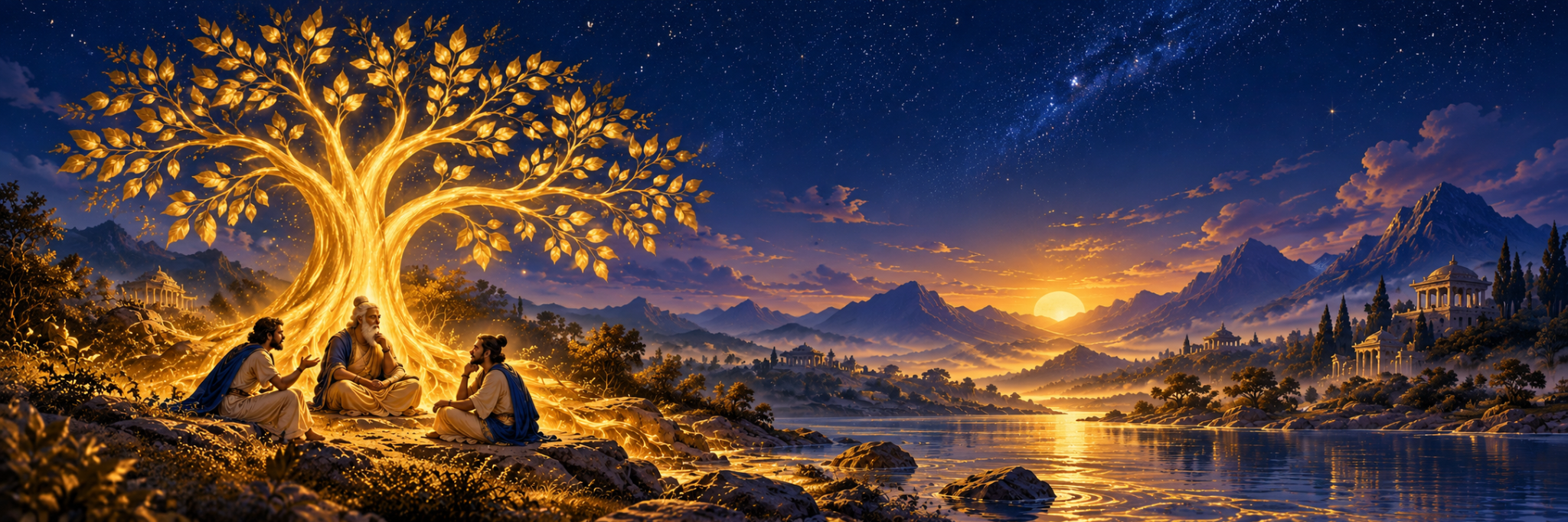
The tree and river recurring throughout the website and books are not merely decorative motifs. Together, they express the nature and movement of the enquiry.
The tree is the Wisdom Tree. Its seed is the first thought. Its roots are the questions, experiences and inherited understanding from which enquiry draws sustenance. Its trunk is sustained reflection; its many branches are differing viewpoints; and its leaves are the insights that emerge from the churning. Its canopy becomes a shared space beneath which one may speak, question, listen or simply pause and reflect.
The river changes its name according to the journey it carries. At times it is the river of knowledge; elsewhere, the river of life, hope or trust. It receives tributaries, encounters bends and obstacles, and continues to deepen as it flows. It does not prescribe a single destination. It is the medium that carries us onwards—from one question to another, from darkness towards light, from inherited understanding towards discoveries still waiting within and beyond us.
The tree gives the enquiry roots; the river gives it movement. Together, they form the visual thread running through The World of Vichar Manthan and the books that emerge from its continuing churn.
But dialogue alone does not define the journey.
Human beings do not think alike, live alike, seek alike or progress alike. Temperament, experience and inclination lead us along different disciplines and different paths.
त्रयी साङ्ख्यं योगः पशुपतिमतं वैष्णवमिति
प्रभिन्ने प्रस्थाने परमिदमदः पथ्यमिति च ।
रुचीनां वैचित्र्यादृजुकुटिलनानापथजुषां
नृणामेको गम्यस्त्वमसि पयसामर्णव इव ॥
trayī sāṅkhyaṃ yogaḥ paśupatimataṃ vaiṣṇavam iti
prabhinne prasthāne param idam adaḥ pathyam iti ca |
rucīnāṃ vaicitryād ṛjukuṭilanānāpathajuṣāṃ
nṛṇām eko gamyas tvam asi payasām arṇava iva ||
Śiva Mahimna Stotra
Human beings, shaped by differing dispositions, follow many paths — straight, winding and varied — yet the destination is one, as waters ultimately find their way to the ocean.
A Subhāṣita illuminates dialogue; the Śiva Mahimna Stotra illuminates the plurality of paths; another verse illuminates the unity underlying many forms of reverence. Across the books, different texts, traditions, disciplines and lived experiences enter into dialogue, each revealing a different facet of the same deeper enquiry.
Just as waters falling from the sky ultimately find their way to the ocean, different forms of reverence point toward the same deeper reality.
This is not an argument for sameness. It is an affirmation that difference need not imply disunity.
This is also the literary philosophy of Vichar Manthan.
Its books do not travel through a single landscape. One may explore civilisation and Dharma; another spirituality, music, ethics, leadership, conflict, duty or the dilemmas of ordinary life. Their forms may differ. Their disciplines may differ. Their arguments may even appear, at first, to stand apart.
Yet beneath them runs a common current.
Each story, each enquiry and each bend in the river becomes another way of approaching the same deeper questions:
How should we understand?
How should we live?
What gives thought, action and purpose their coherence?
The aim is therefore neither uniformity of thought nor a prescribed conclusion.
It is to create a space in which different paths may be examined honestly, different viewpoints may be churned without fear, and deeper meaning may emerge through the encounter itself.
From Plurality, Unity.
From Fragmentation, Cohesion.
From Ignorance, Liberation.
Different bends. Different landscapes. Different disciplines. One underlying current.
Through dialogue, understanding emerges.
Through different paths, Dharma reveals its unity.
Come. Explore. Immerse yourself in the Manthan.
Before we immerse ourselves in the churn — in the Manthan — let us first understand why this churn is needed. Let us ask:
Why this journey?
Vichar Manthan began with a simple concern. Much of what earlier generations absorbed naturally through family, language, tradition and lived culture can no longer be taken for granted — whether in India or beyond its shores.
This is an attempt to share that inheritance with the generations that follow, while inviting those who received it earlier to revisit it through reflection, dialogue and open-ended enquiry.
Not merely to preserve what was inherited, but to understand it anew — together.